
Last updated October 30, 2026
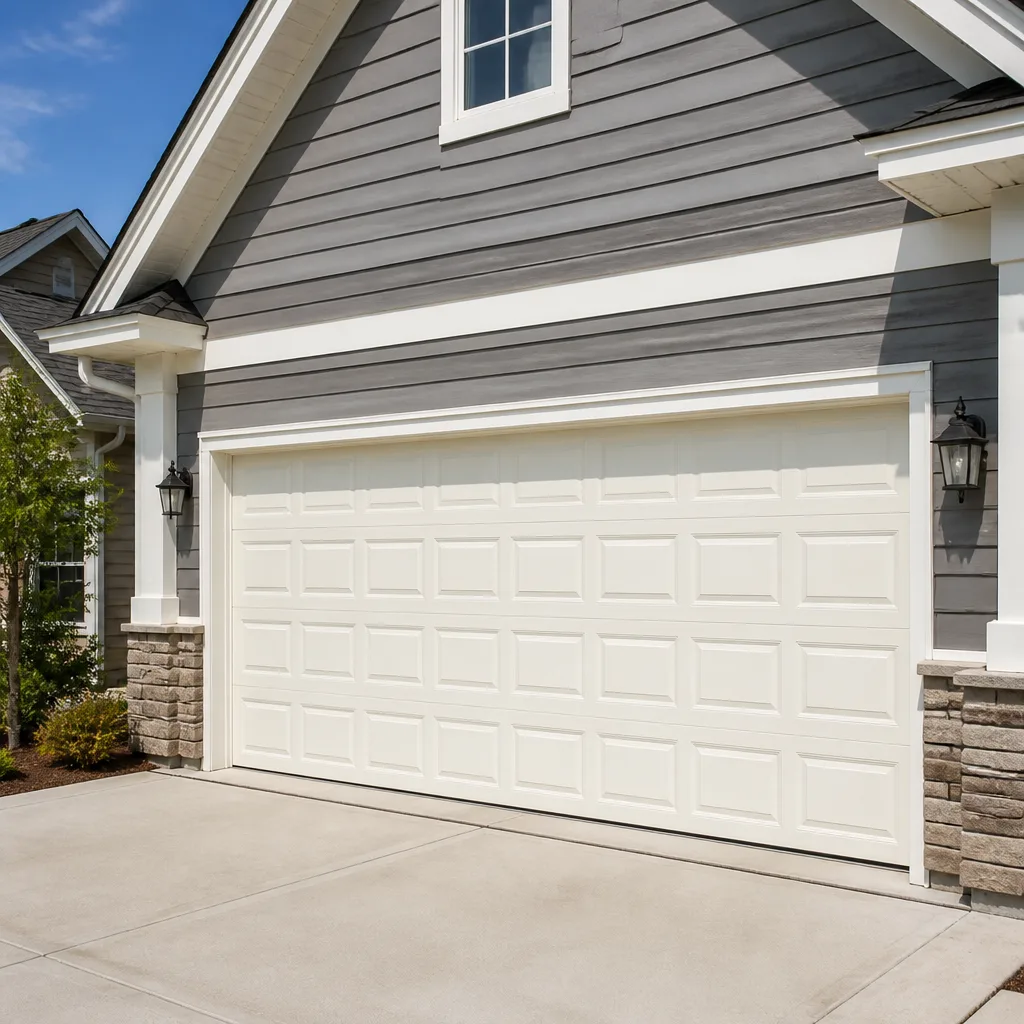 Raised-panel steel
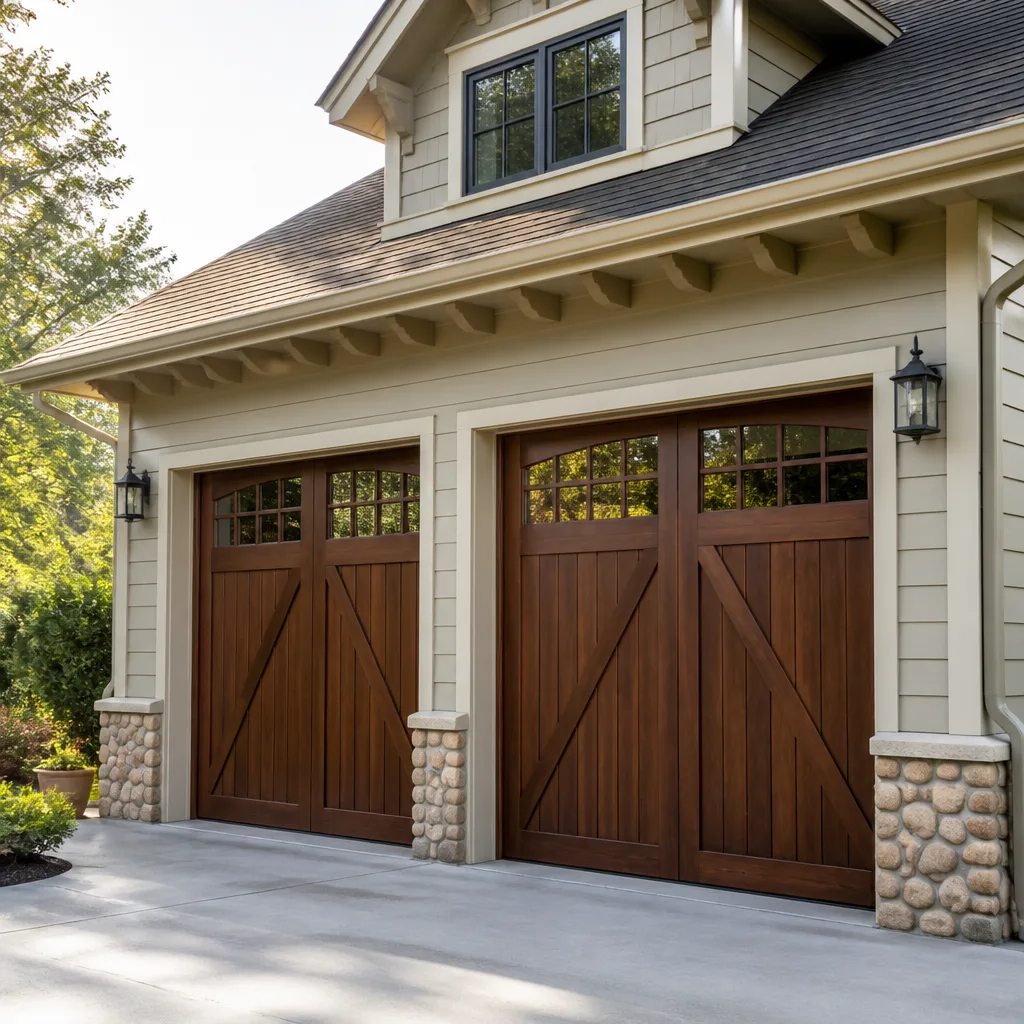 Carriage house
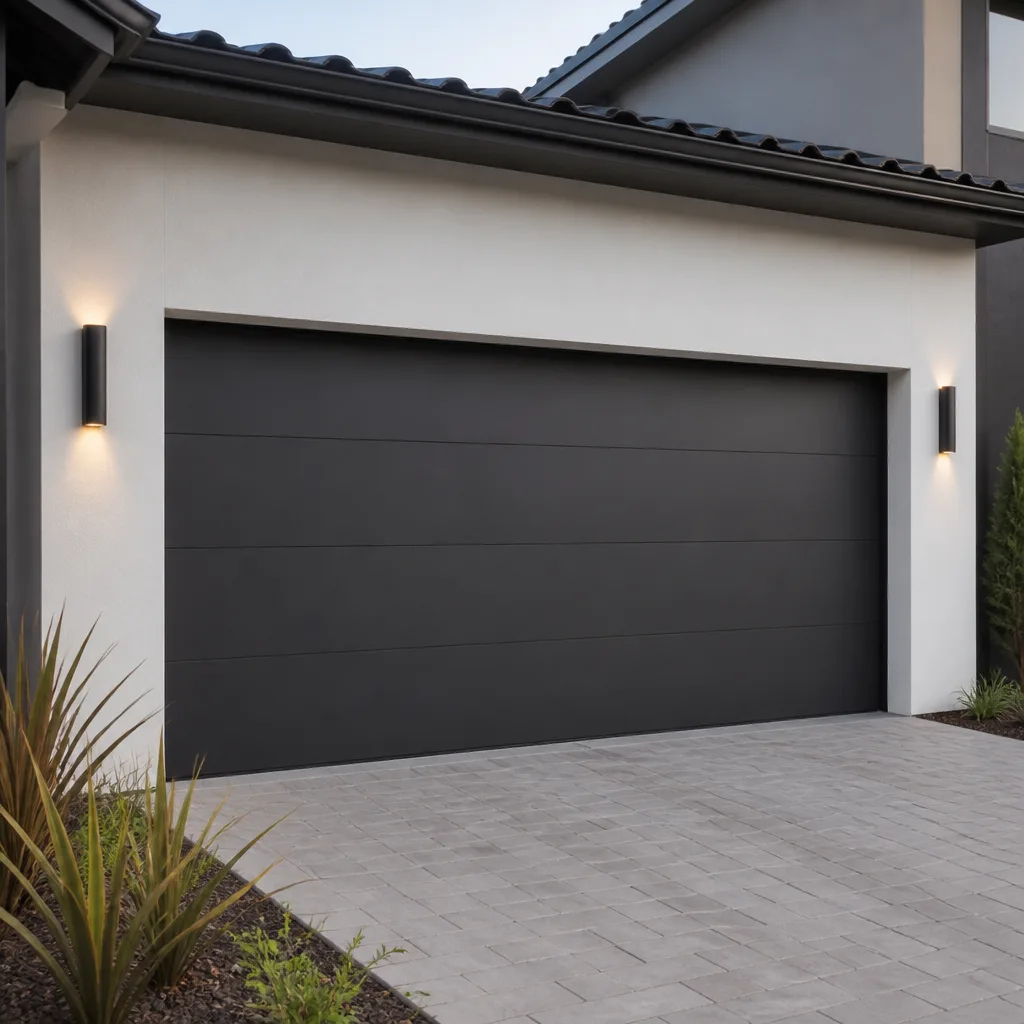 Modern flush
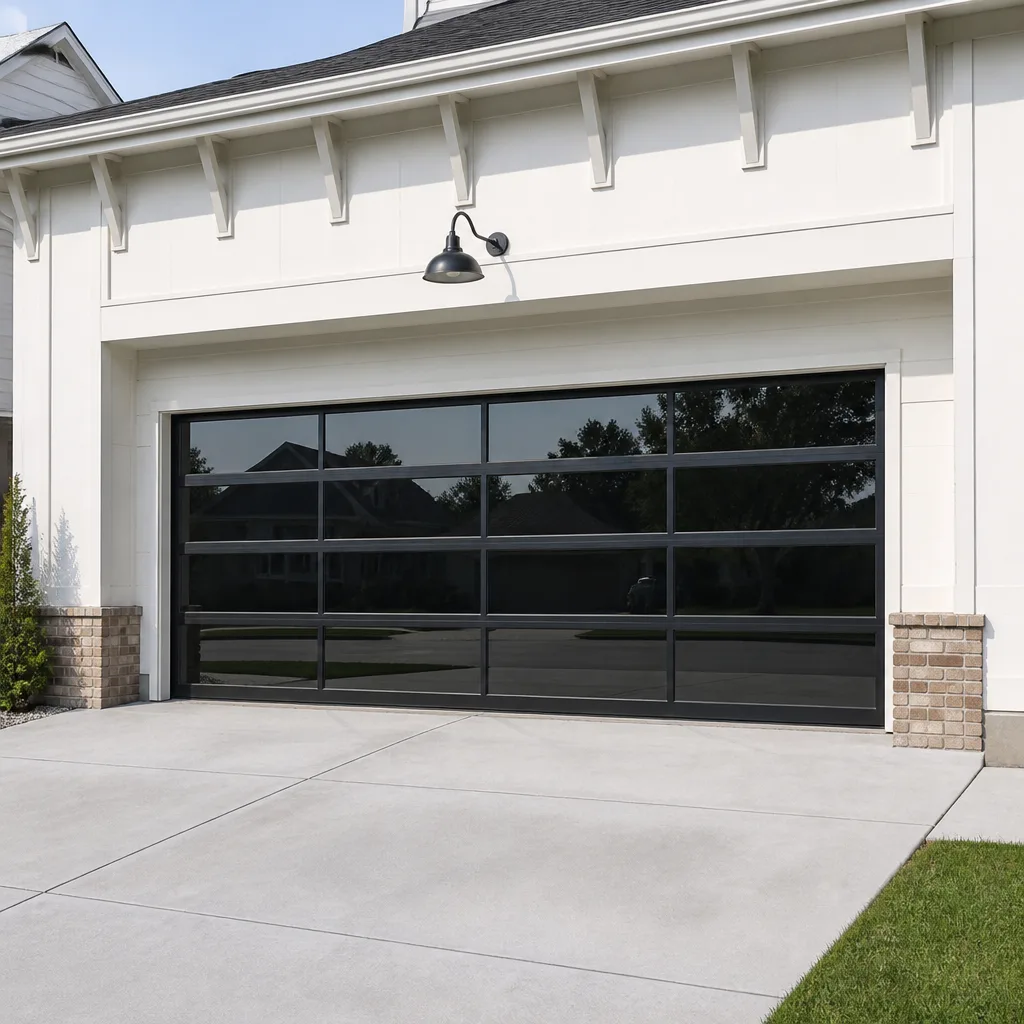 Full-view glass
 LiftMaster openers
 Chamberlain openers
Full 25-point door and opener safety check with every visit - springs, cables, rollers, tracks, and your LiftMaster or Chamberlain opener included
You get a price before we start. It does not change when the truck arrives.
Get your free estimateGarage Door Repair Maintenance Checklist for Huntington Beach Homeowners
Most garage door maintenance advice reads like it was written in a garage in Ohio. That’s a problem, because your door in Huntington Beach is aging differently. Salt air, June Gloom humidity cycles, and Santa Ana wind gusts above 40 mph aren’t just weather patterns here. They’re mechanical stressors that quietly work on your springs, cables, rollers, and seals every single day. A generic Garage Door Repair Troubleshooting: Common Problems and How to Fix Them checklist will cost you money in Huntington Beach. The number one mistake we see isn’t skipped maintenance. It’s using the wrong lubricant. Standard silicone spray, the kind in most DIY kits, washes off faster in our high-humidity coastal air. Within months, torsion springs in Huntington Beach are running metal-on-metal. That’s how a simple maintenance task turns into an $800 spring replacement. This guide is a Huntington Beach-specific maintenance plan, built around our actual climate and the failure patterns we see in local garages.
Quick Answer
A garage door maintenance checklist for Huntington Beach homeowners should follow a three-times-per-year inspection schedule: May (pre-June Gloom moisture load), August (post-Gloom humidity assessment), and October (pre-Santa Ana wind season). Use marine-grade lithium grease on springs and hinges, not standard silicone spray. Inspect bottom seals monthly for salt crystallization and sand abrasion. Test balance and safety reversal monthly. Tighten all bracket and hinge bolts before Santa Ana season, because high-wind vibration loosens hardware faster than most homeowners realize.
Styles & brands we work with
Table of Contents
- What Makes Huntington Beach Garage Doors Different
- The Right Lubrication for Salt Air and Humidity (Not What DIY Kits Tell You)
- Bottom Seals and Weatherstripping: Salt, Sand, and the Failure Mode Inland Checklists Miss
- Santa Ana Wind Season Prep: Cables, Brackets, and Vibration
- Month-by-Month Maintenance Schedule for Huntington Beach
- Photograph These Components Annually: Your Baseline Against ‘Looks Worn’
- The Monthly Balance Test Every Huntington Beach Homeowner Should Do
- Opener Maintenance: Motor, Chain, and Safety Sensor Checks
What Makes Huntington Beach Garage Doors Different
If you live north of Talbert Avenue or south of Seapoint, you already know the air here is not neutral. Huntington Beach sits directly on the Pacific, and that means airborne salt, persistent humidity, and sudden dry-wind events. Your garage door is the largest moving object on your home. It’s also the most exposed mechanical system you own. Here’s what Huntington Beach specifically does to garage door hardware:
- Salt air accelerates spring corrosion. Torsion springs on homes within two miles of PCH develop surface rust faster than the same springs in Fountain Valley or Westminster. Surface rust isn’t cosmetic. Rough metal increases friction, which increases heat, which shortens spring life. On a spring rated for 10,000 cycles, coastal corrosion can shave off 3,000 to 4,000 cycles.
- June Gloom is a moisture event, not a temperature event. From late May through July, overnight marine layer trapped against the coast pushes relative humidity in garages above 80% for hours at a time. That’s condensation on metal. It settles on hinges, rollers, cables, and opener rails. Repeated moisture cycling is what causes rust blooms on hardware that never gets wet from rain.
- Santa Ana winds loosen hardware. In October and November, dry northeast winds gust over 40 mph. Your garage door catches that wind like a sail. The pressure differential stresses hinge bolts, bracket screws, and cable tension. We regularly see homeowners in the Bolsa Chica and Edwards Hill areas with loose motor brackets after the first Santa Ana event of the season.
- Sand is an abrasive, not a nuisance. Fine beach sand blown from the shoreline works its way into bottom seal folds and roller tracks. It grinds against weatherstripping like sandpaper and contributes to premature nylon roller wear.
These four factors mean your Huntington Beach maintenance checklist should not look like one from a national site. It has to account for corrosion, condensation, wind vibration, and abrasive sand. The sections below walk through each based on what we’ve documented at Corner Post Garage Door Repair home on doors across Huntington Beach.
The Right Lubrication for Salt Air and Humidity (Not What DIY Kits Tell You)
Lubrication is the single most effective maintenance task you can do on a garage door. It’s also the most commonly botched. Here’s the direct answer: In Huntington Beach, use white lithium grease on torsion springs, hinge pins, and bearing plates. Use a marine-rated dry lubricant on tracks, rollers, and opener chains. Do not use WD-40 on springs or hinges. Do not use standard silicone spray as your primary spring lubricant. Here’s why.
- White lithium grease clings. It’s a thick, water-resistant grease that stays on springs and hinge pins through the June Gloom humidity cycle. Standard silicone spray is thin. Under high humidity it breaks down faster, and in salt air it loses adhesion. Within two to three months, the springs are effectively unlubricated. Metal-on-metal contact on torsion springs wears the spring coating and accelerates rust.
- Marine-rated dry lubricant repels salt. Products labeled for marine use are formulated to resist salt spray and damp air. They dry to a film instead of staying wet, so they don’t attract sand the way grease would on a track. Apply to the opener rail, track interior, and roller bearings. The dry film also helps prevent salt crystals from adhering to the metal.
- Application intervals matter more than product volume. In Huntington Beach, apply lubricant three times a year: early May (before the Gloom), late July (after the Gloom), and mid-October (before Santa Ana winds). That’s the correct cadence for our humidity and wind schedule. More is not better. Over-lubricating tracks attracts grime and sand, which turns into a gritty paste that accelerates roller wear.
How to apply correctly: Wipe down springs and hinges with a clean rag first. Dirt and old grease should come off before new grease goes on. Apply white lithium grease to the top and sides of each spring coil, not just the center. Work it lightly into the coils with a rag. On the opener chain, apply a light coat of marine dry lubricant and wipe off excess. On nylon rollers, a single drop of lubricant on the roller bearing is enough. Never lubricate the roller track itself beyond a dry film wipe.
One note: if your door has a LiftMaster or Chamberlain opener with a belt drive, skip the chain entirely and focus on the rail. Belt drives are quieter and require no lubrication. The bearings and hinges on the door itself still need the lithium grease treatment regardless of opener brand.
Bottom Seals and Weatherstripping: Salt, Sand, and the Failure Mode Inland Checklists Miss
Bottom seals in Huntington Beach fail differently than they do anywhere else in Orange County. We’ll be specific: salt crystallization and sand abrasion are the two failure modes. Inland checklists mention rips and cracks. Your seals are more likely to fail from chemical breakdown and mechanical grinding.
Salt crystallization: The rubber or vinyl bottom seal on your garage door is permeable. It absorbs moisture from the air. When that moisture evaporates, it leaves behind salt residue. Over repeated June Gloom cycles, salt crystals form inside the seal material itself. Those crystals create micro-tears that weaken the seal from the inside out. The seal may look fine on the outside in May. By September it has lost elasticity and can no longer compress properly against the garage floor. Result: daylight, bugs, and moisture intrusion along the bottom edge.
Sand abrasion: Every time you close the door, the bottom seal compresses against the concrete slab. If fine beach sand is present, which it routinely is on coastal Huntington Beach driveways, the seal is being sanded every single time the door cycles. The trailing edge of the seal wears thin. Once it’s thin enough, it stops sealing altogether. Check the bottom 6 to 12 inches of the seal near the sides of the door. If it’s noticeably thinner there than at the center, that’s sand abrasion, not regular wear.
How to inspect:
- Close the door completely.
- Run your hand along the bottom seal, feeling for thin sections, cracks, or hard spots where salt crystallization has stiffened the material.
- Look for daylight visible under the seal. Any gap wider than 1/8 inch means the seal is no longer doing its job.
- Check the seal’s T-channel connection. Salt can corrode the metal retainer holding the seal in place, causing it to sag or detach.
- If you see white powder residue on the seal or the concrete beneath it, that’s salt. Wipe it down and inspect the material underneath for brittleness.
Replacement seals are a relatively low-cost part. The labor to replace them is straightforward. But catching seal failure early prevents a larger problem: water intrusion during winter rain events, which leads to rusted tracks and damp garage interiors. In Huntington Beach, we recommend inspecting the bottom seal monthly, not just at the annual maintenance check. It’s a two-minute check that prevents a lot of downstream damage.
Santa Ana Wind Season Prep: Cables, Brackets, and Vibration
Santa Ana winds are not a myth. They are a mechanical reality for every garage door in Huntington Beach. The winds typically arrive in October and November, sometimes extending through the winter. Wind speeds routinely exceed 40 mph along the coast. When that wind hits a closed sectional garage door, it creates repeated pressure surges. Those surges do two things: they vibrate every bolt and screw on the door assembly, and they stress the lift cables unevenly.
We’ve seen doors in the Huntington Harbour area come into October with loose motor mount brackets because the previous season’s winds worked the lag screws loose by a quarter turn. A quarter turn doesn’t sound like much, but a motor that moves during operation puts uneven wear on the chain or belt and increases the load on the opener gears. The fix is simple: check and tighten before the winds arrive.
October Santa Ana preparation checklist:
- Tighten all hinge bolts. There are four to six hinges per panel section. A 7/16-inch socket wrench is the standard size. Work top to bottom, checking each bolt. Do not overtighten. Snug is correct. Overtightening strips the door’s metal or compresses the panel.
- Tighten the motor bracket bolts. The opener motor is mounted to the garage ceiling on a metal bracket. Check the two to four lag screws holding that bracket. If they’ve worked loose, tighten them. If a lag screw spins without tightening, the hole is stripped. That’s a pro job, not a DIY fix.
- Inspect lift cables for fraying. With the door closed, examine the lift cables running along each side of the door. Run a rag along each cable. If the rag catches on broken strands, the cable is fraying. Do not attempt to remove a cable under tension. A frayed cable is a safety issue. Call a professional.
- Check the torsion spring for gaps or separation. Look at the spring mounted above the center of the door opening. There should be no visible gap between the coils. A gap means the spring is fatiguing. This is not a self-service repair. Torsion springs are under extreme tension and can cause serious injury if handled incorrectly. If you see a gap, call us immediately.
- Test the door’s balance in both directions. Pull the emergency release cord (with the door closed) and manually lift the door halfway. A properly balanced door stays at the halfway point without falling or rising. If it falls, the springs are weak. If it rises, the springs are overwound. Either condition will stress the opener motor and shorten its life.
We do appliance-level checks on doors in Huntington Beach every fall. The pattern is consistent: homes within a mile of the beach show more loose hardware after wind season than homes east of Beach Boulevard. If you’re in a coastal neighborhood, add one extra bolt check in December just to be safe.
Month-by-Month Maintenance Schedule for Huntington Beach
Mostgarage door maintenance guides organize tasks by season: spring, summer, fall, winter. That’s fine for places with four distinct seasons. Huntington Beach doesn’t work that way. Our climate has three functional seasons: the June Gloom marine layer season (May through July), the late-summer dry period (August through September), and the Santa Ana wind season (October through November). We also get occasional winter rain storms from December through February. Here’s a month-by-month schedule that matches our actual climate.
May: Pre-Gloom Lubrication and Seal Check
- Full lubrication cycle: white lithium grease on springs and hinges, marine dry lubricant on tracks and opener chain/belt rail.
- Inspect bottom seal for winter rain damage. Replace if cracked, thin, or salt-stiffened.
- Test the auto-reverse safety feature. Place a 2×4 flat on the ground under the door. Close the door. It should reverse upon contact and return to open position. Do this monthly from May through October.
June: Condensation Monitoring
- Check for condensation on opener rail, springs, and hardware. Wipe down any moisture you see. Moisture that sits on bare metal for weeks encourages rust.
- Listen for squeaks or grinding during operation. Squeaks mean dry hinges. Grinding means worn rollers. Address squeaks with grease. Grinding warrants a roller inspection.
July: Post-Gloom Assessment
- Inspect all hardware for early rust spots. Surface rust on hinges and brackets is common after sustained humidity. Light rust can be cleaned and touched up. Deep rust on springs or cables means replacement is on the horizon.
- Run a balance test. Pull the emergency release and manually lift the door halfway. It should stay put.
- Re-apply white lithium grease to hinges if you hear any noise.
August: Sand and Track Cleaning
- Vacuum or wipe out the track channels. Remove any accumulated sand, debris, or old grease paste.
- Inspect rollers. Nylon rollers with ball bearings wear smoothly. Steel rollers without bearings are more prone to friction wear. If rollers are cracked, chipped, or wobble, plan a replacement.
- Check the weatherstripping on the garage frame sides and top, not just the bottom seal. Coastal sun and salt air break down exterior vinyl seals faster than inland.
September: Opener Motor and Electrical Check
- Check the opener motor mounting bracket for security.
- Inspect the opener chain or belt for slack. A chain that sags more than 1 inch below the rail has stretched. Belts should be taut without being tight.
- Test the wall control and remotes. Replace remote batteries once a year, ideally in September so you’re never caught with a dead opener remote in the winter rain.
- Check the safety sensor alignment. Both sensors at the base of the door should have steady indicator lights. If one light is blinking, clean the lens and realign.
October: Santa Ana Wind Preparations
- Complete the full Santa Ana prep checklist from the previous section: tighten bolts, inspect cables, check torsion spring, test balance.
- Cycle the door three times and watch for any jerky movement or uneven travel.
- If you have a LiftMaster or Chamberlain opener, run a force setting test. The door should reverse with minimal resistance if you place a hand under it during closing. If it continues with noticeable force, the force setting is too high and the reversal system needs adjustment.
November through February: Winter Rain Checks
- Inspect bottom seal monthly. Rainwater intrusion through a worn seal is the top cause of rusted tracks we see in Huntington Beach winters.
- Keep track channels clear. Moisture combined with sand makes a paste that binds rollers.
- Run the door once a day even if you don’t leave the house by car. A door that sits closed for weeks in damp air develops rust spots on bearing surfaces that a daily cycle would wear off.
March and April: Light-Maintenance Window
- These are the driest and most stable months in Huntington Beach. Use them for anything that required repair but wasn’t urgent: roller replacement, hinge replacement, seal replacement, or opener tune-ups.
- This is also the best time to schedule an annual full inspection. Technicians have clearer scheduling windows, and any repair work can be completed before the Gloom and wind seasons arrive.
Photograph These Components Annually: Your Baseline Against ‘Looks Worn’
One of the most useful habits a Huntington Beach homeowner can build is annual photo documentation of their garage door hardware. It takes ten minutes once a year. The payoff is a visual baseline you can reference when someone tells you a component “looks worn” and needs replacement. Without a baseline, you’re trusting a verbal description. With a baseline, you can see the change yourself.
Here’s what to photograph and why:
- Torsion spring (if you have one): A torsion spring is the long spring above the door opening. Photograph it from three feet away, straight on. Each year, compare the photo to the current condition. A spring that’s developing gaps between coils will show the change over time. A spring that’s accumulating rust will darken visibly. This is your single most valuable baseline photo.
- Extension springs (if applicable): On older doors, you may have two long springs running parallel to the tracks on either side. Photograph both from the side and from below. Look for stretching or deformation. Extension springs stretch as they age. A side-by-side annual comparison makes the change obvious.
- Lift cables: Photograph the cables where they attach at the bottom bracket and where they wrap around the drum at the top. Cables fray near attachment points first. An annual photo lets you spot the first broken strand months before the cable fails outright.
- Rollers and hinges: Photograph two or three different hinge points up close. Hinge wear shows as elongated holes or a visible gap where the roller stem sits. Year-over-year comparison shows the rate of wear.
- Bottom seal: Photograph the bottom seal from inside the garage with the door closed. The seal should compress evenly against the floor. An annual photo captures the original compression profile so you can see when the seal starts flattening or thinning.
- Opener motor and rail: One photo of the opener from below, showing the rail, chain/belt, and motor unit. Chain slack and belt wear are visible in annual comparisons.
- Track alignment: Photograph the track from the floor looking up, showing the curve where the track transitions from vertical to horizontal. Track misalignment over time shows as a gap between the track and the wall or the track and the door rollers.
Store these photos in a folder on your phone or computer with the date. When a technician or a friend tells you a spring is worn, a cable is fraying, or a seal needs replacement, you can pull up last year’s photo and see the difference yourself. That’s what we do as professionals. We document before-and-after because it removes the guesswork from the recommendation. You deserve the same reference point for your own door.
We work on Clopay and Amarr doors in Huntington Beach regularly, and the same baseline logic applies regardless of brand. Door hardware wears over time no matter who made it. The question is always: worn compared to what? A photo answers that question.
The Monthly Balance Test Every Huntington Beach Homeowner Should Do
The balance test is the highest-value diagnostic you can run on your garage door. It tells you whether your springs are doing their job. Springs counterbalance the weight of the door so the opener motor only has to do a fraction of the work. When springs weaken, the motor works harder. A motor working harder runs hotter and wears out faster. An opener that should last 10 to 15 years on a properly balanced door can fail in 5 to 7 years if it’s straining against a heavy, unbalanced door.
How to run the balance test:
- Close the garage door completely.
- Pull the emergency release handle. This is a red cord hanging from the opener rail. Pulling it disengages the opener from the door so you can move the door manually.
- Lift the door by hand to the halfway point, approximately four feet off the ground.
- Let go. A properly balanced door will stay at the halfway point without moving. It may drift up or down an inch. That’s fine. More than a few inches of drift indicates a spring problem.
- If the door falls toward the ground, the springs are weak. They are no longer counterbalancing the door’s weight effectively.
- If the door rises on its own, the springs are overwound or the door is too light. Both conditions are unusual and warrant a professional inspection.
- Raise the door fully and lower it manually. It should move smoothly at every point in the travel. Any binding, catching, or uneven resistance indicates a track or roller issue.
- Re-engage the emergency release by pulling the cord toward the opener or running the opener until it reconnects.
Do this test monthly in Huntington Beach. Salt corrosion and humidity cycling gradually weaken springs over time, and the progression is slow enough that you won’t notice it in daily use. But the balance test catches weakening springs months before they fail. Springs that are weakening can be replaced on a schedule that works for you, rather than failing at 7:30 on a morning you need to be at work.
Safety note: If you have an older door with extension springs (the long springs on either side of the tracks), be aware that these are under high tension even at rest. The balance test is still safe to do. But if you see a broken spring or a frayed cable while checking, do not attempt any repair. Both are dangerous because they’re under tension. Call a professional for Garage Door Repair who works on Genie and Wayne Dalton legacy doors as well as modern systems.
Opener Maintenance: Motor, Chain, and Safety Sensor Checks
Most garage door maintenance guides focus on the door and skip the opener. But in Huntington Beach, the opener is fighting the same environmental factors as the door: humidity, salt, and temperature swings. And because most openers contain both a motor and a motherboard, their failure modes are more complex. Here are the opener-specific maintenance tasks that matter.
- Safety sensor alignment and cleanliness. The two photo-eye sensors sit near the floor on either side of the garage door opening. They transmit an invisible beam. If the beam is interrupted, the opener refuses to close the door. That’s a safety feature. But salt air and dust can fog the sensor lenses, and vibration can knock the sensors out of alignment. Check the indicator lights on both sensors monthly. If one light is blinking, clean the lens with a soft cloth and gently realign the sensor until the light turns steady.
- Force setting verification. The force setting controls how much resistance the opener will push against before reversing. If the setting is too high, the door will continue closing even if it hits an obstruction, which is a safety hazard. Test this by opening the door fully, then placing your hand flat against the bottom of the door as it closes. The door should reverse immediately upon contacting your hand with minimal force. If it pushes through your hand resistance, the force setting needs adjustment. Do not adjust force settings yourself unless you’re familiar with your specific opener model. This is a task we handle regularly.
- Chain tension check. Chain-drive openers are common on older Huntington Beach homes. Over time, the chain stretches. A sagging chain makes noise and can skip teeth on the sprocket. Check the chain by looking at it along the rail. If it sags more than an inch below the rail at the midpoint, it needs tensioning. Belt-drive openers, common on newer LiftMaster and Chamberlain systems, do not stretch the same way and generally need no tension adjustment.
- Motor mount inspection. The opener motor is bolted to a ceiling-mounted bracket. Santa Ana winds rock the garage door, and that rocking transfers to the rail and the motor mount. Check the lag screws holding the mount. If they’re loose, the motor will shift during operation, which leads to uneven travel and increased wear on the gears.
- Gear inspection. Most residential openers use a nylon gear inside the motor housing. Nylon is quieter than steel, but it also wears. When the gear wears out, the motor runs but the door doesn’t move, or the door moves in jerks. There’s no maintenance fix for a worn gear. It’s a replacement part. The maintenance point is to catch it early by listening for a grinding or buzzing sound, which indicates the gear teeth are slipping.
We see a lot of Genie and Chamberlain openers in Huntington Beach that have been in service for 10 years or more. The motors themselves are often functional. What fails first is usually the nylon gear, the chain, or the logic board. Logic boards are sensitive to humidity and salt residue. Keeping the opener motor clean, dry, and free of coastal grime extends the life of the electronics. A simple wipe-down of the exterior unit every few months is worthwhile.
Common Mistakes to Avoid
- Using WD-40 as a lubricant. WD-40 is a water displacer and solvent, not a lubricant. It cleans, then evaporates. On door springs, it leaves them drier than before. On tracks, it attracts sand and creates a paste that accelerates roller wear. Use white lithium grease on springs and marine dry lubricant on tracks.
- Lubricating the track itself. The track does not need lubrication. The rollers need lubrication at their bearings. A lubricated track collects grit and grime, and the rollers drag through it. Keep tracks clean and dry.
- Applying grease to the safety sensor lenses. Clean sensor lenses with a dry cloth only. Any lubricant or cleaner on the lens will fog it and disable the safety beam.
- Skipping the monthly balance test because “the door works fine.” The balance test catches weakening springs before they break. By the time a spring breaks, the door may not move at all. And a door that visibly works fine may be straining the opener motor because the springs are fading. The balance test is a 30-second check. Do it monthly.
- Replacing only one spring when the other is the same age. Torsion and extension springs are rated for a certain number of cycles. If one spring has failed, the paired spring has likely reached the end of its service life too. Replacing only one means you’ll be back for the other within months. The right fix is to replace both. This is standard practice in Huntington Beach, where salt exposure tends to age springs evenly.
- Ignoring a slightly noisy door. A grind or squeak is an early-warning signal. It means friction is present, and friction means heat, and heat means wear. A noisy door that continues to move is not fine. It’s telling you something specific. Quiet doors are healthy doors.
- Painting over rust without addressing the cause. Surface rust on hinges or brackets can be sanded and painted. But if the rust is on a spring, painting it does nothing except hide the problem. Springs flex under load, and paint flakes off the moment the spring coils twist. A rusted spring is a weakening spring, not a cosmetic issue.
See the difference
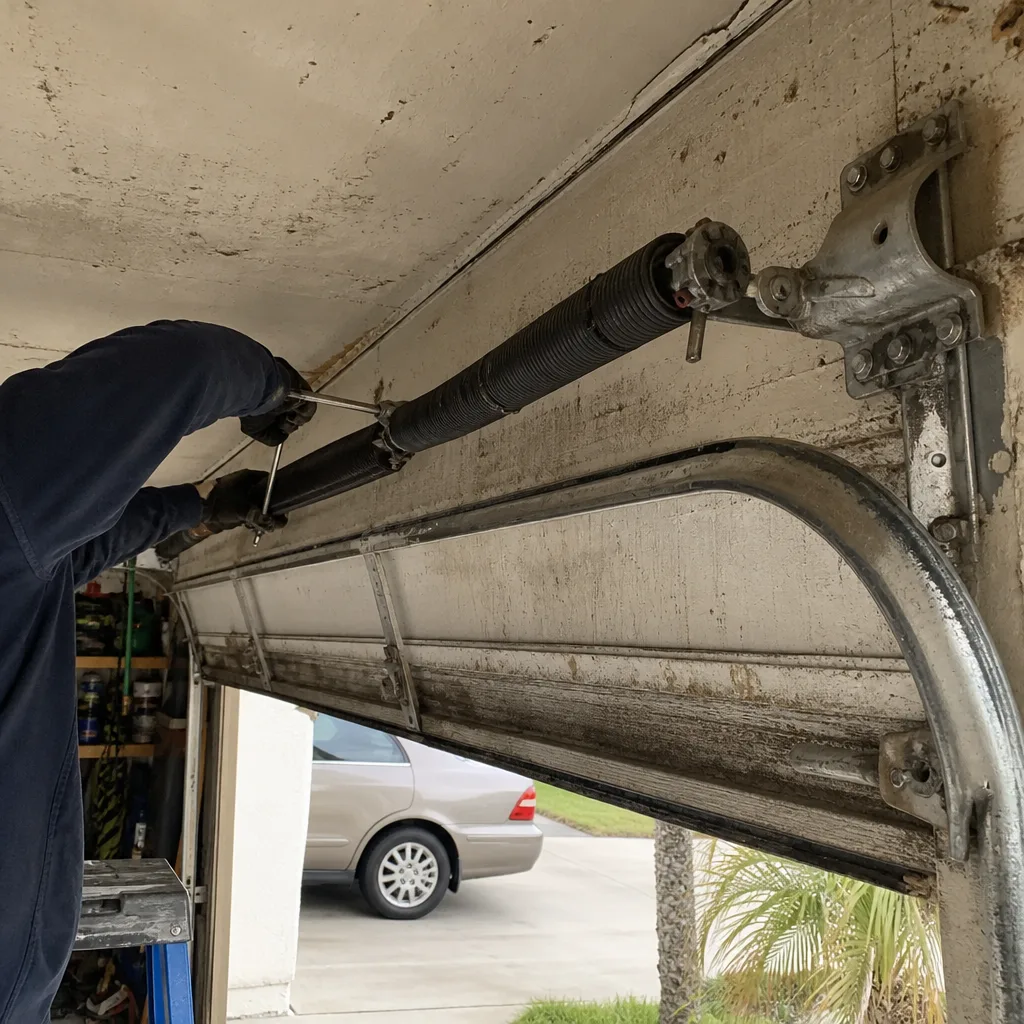 Before
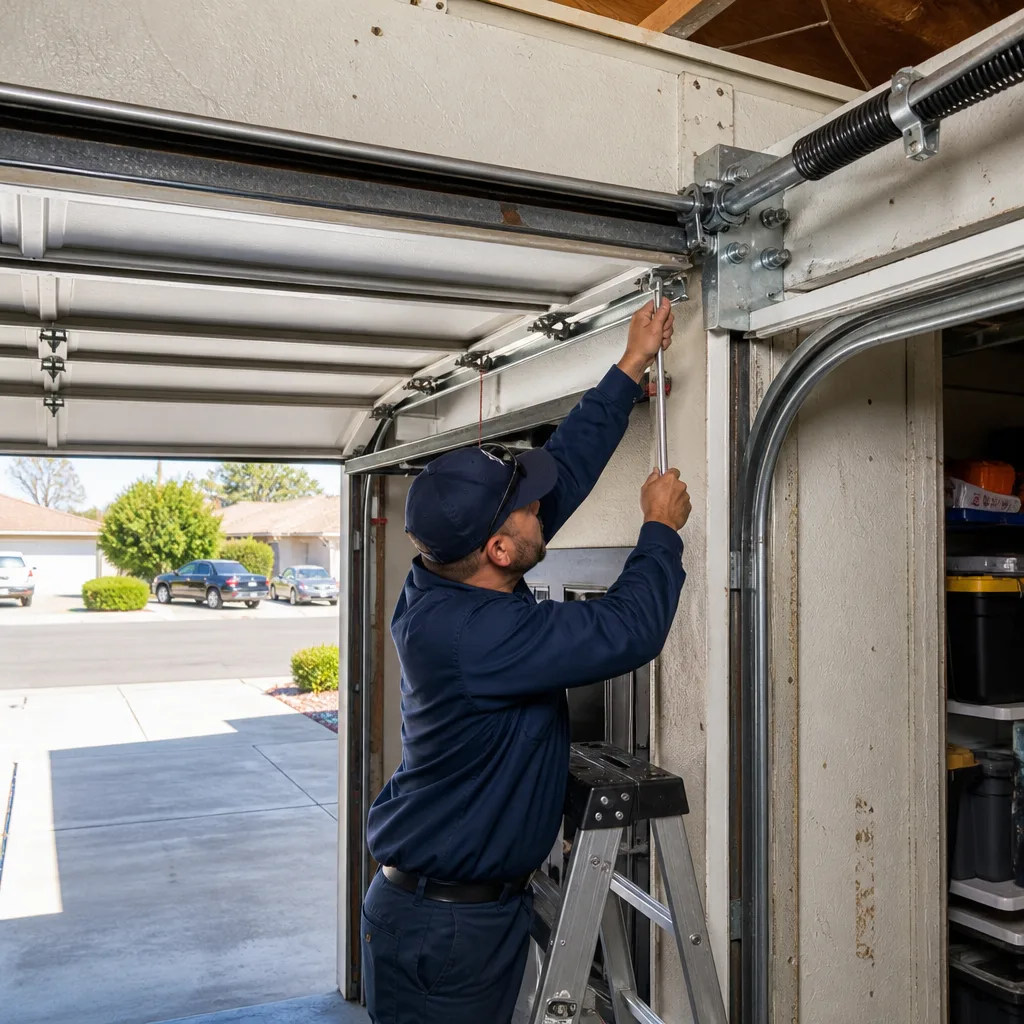 After
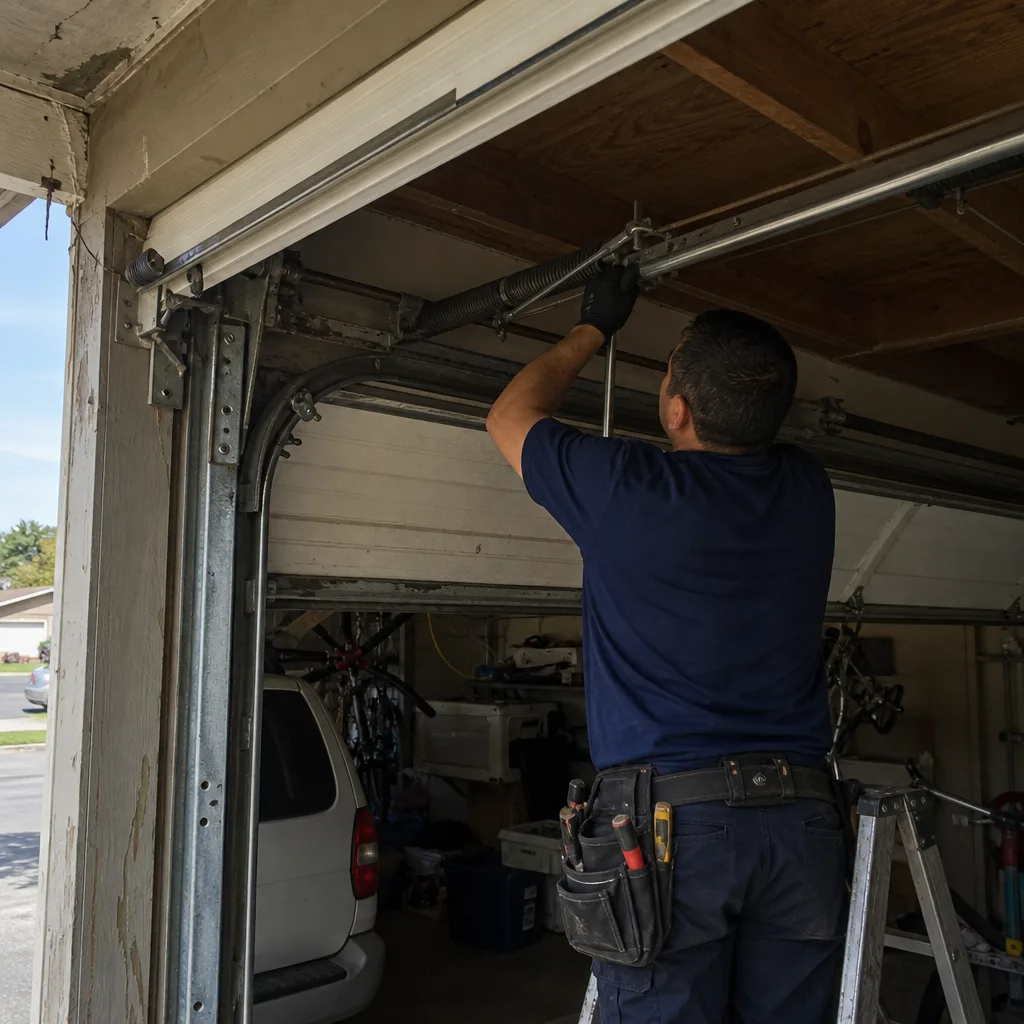 Before
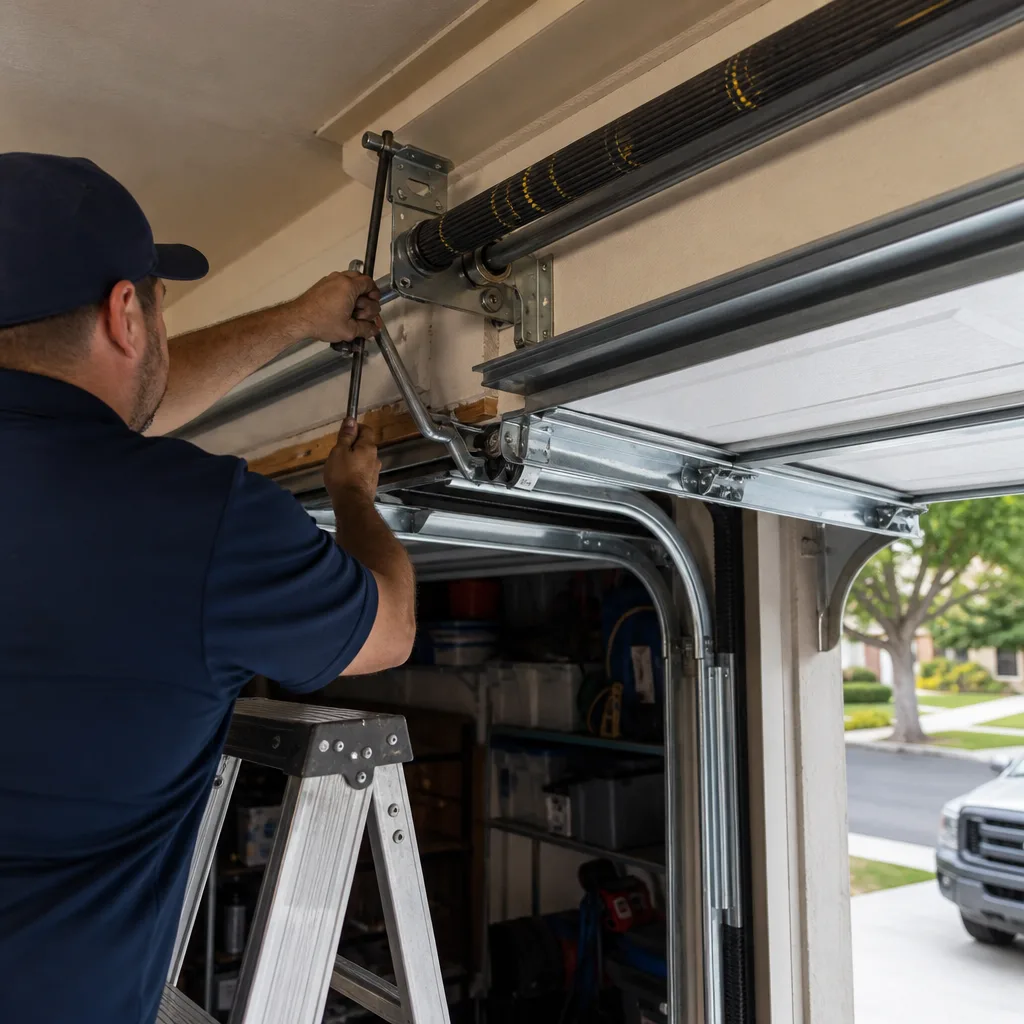 After
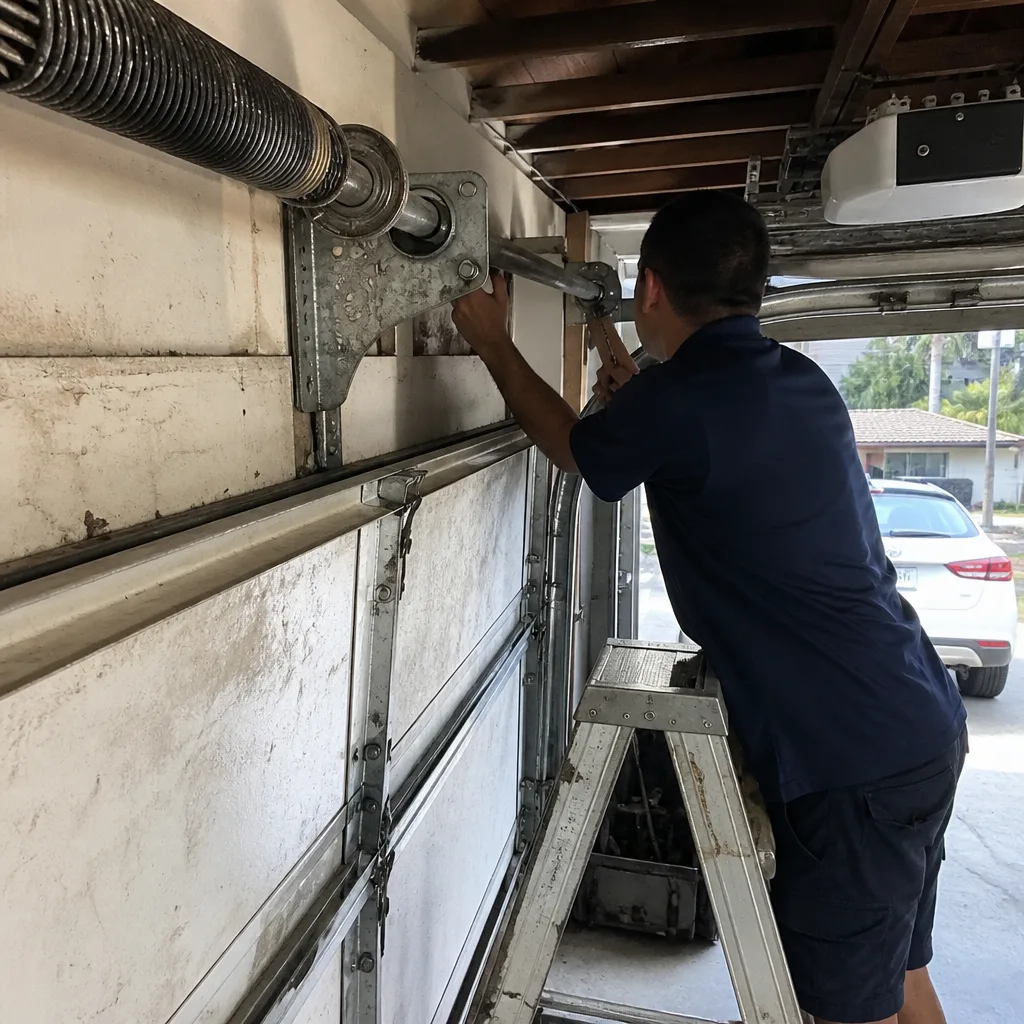 Before
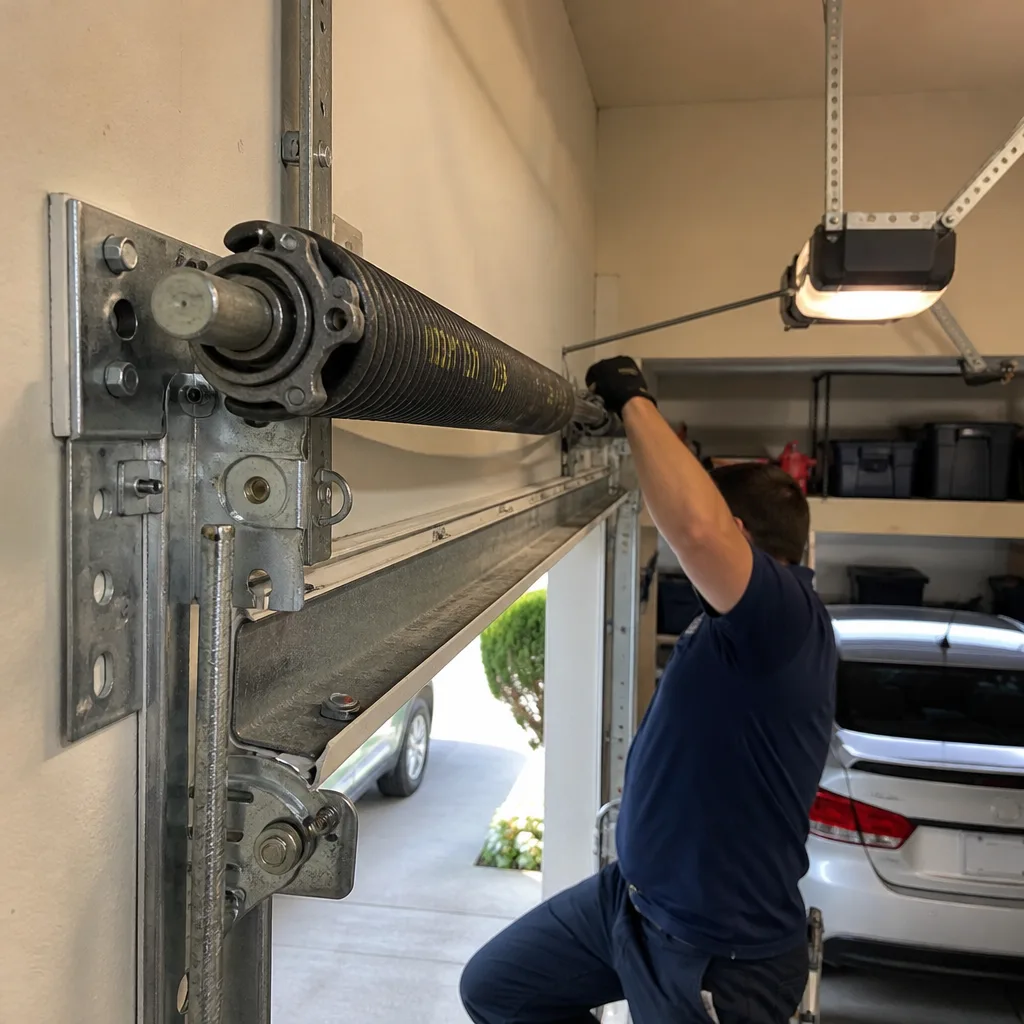 After
When to Call a Professional
Some garage door tasks are genuinely dangerous. Torsion springs store enormous tension. A broken cable under load can snap with enough force to cause serious injury. Extension springs can release suddenly. If you have a broken spring, a frayed cable, a door that’s visibly crooked in the tracks, or a door that falls quickly when you disengage the opener, do not attempt a DIY repair. The parts are under tension. The risk is real. A trained professional has the tools and the experience to release that tension safely. For roller and hinge replacement on heavy double-wide doors, we also recommend calling a pro. The door weighs 150 to 300 pounds, and losing control of it can cause injury or property damage. Corner Post Garage Door Repair offers free estimates in Huntington Beach, and we work on all major brands, including LiftMaster, Chamberlain, Genie, and Clopay. Call (833) 620-3836 to schedule. If your opener motor runs but the door doesn’t move, that’s a gear or logic board failure. We handle garage door opener repair in Cudahy and throughout the Huntington Beach area. The repair is typically straightforward for a specialist, but it requires parts that aren’t available at home centers.
Frequently Asked Questions
In Huntington Beach, lubricate your garage door three times per year: early May before June Gloom, late July after the humidity cycle breaks, and mid-October before Santa Ana winds. Use white lithium grease on springs and hinges, and a marine-rated dry lubricant on tracks and opener chains. The coastal air breaks down standard silicone spray faster, so the product choice and the cadence both matter. If you hear squeaks between scheduled lubrications, call (833) 620-3836 for an inspection rather than over-applying.
Yes, salt air damages garage door hardware through corrosion that’s both chemical and mechanical. Salt accelerates rust on torsion springs, which roughens the spring surface and increases friction. Salt also crystallizes inside vinyl bottom seals, causing micro-tears that weaken the seal from the inside. Homes within two miles of PCH see the fastest corrosion rates in Huntington Beach. The countermeasure is a maintenance schedule that accounts for salt exposure: marine-rated lubricants, frequent seal inspections, and annual hardware documentation. For Garage Door Warning Signs: A Huntington Beach Homeowner’s Reference Guide, see our detailed breakdown.
The most common garage door failure we see in Huntington Beach is bottom seal deterioration, followed closely by torsion spring fatigue. Bottom seals fail because salt crystallization and sand abrasion work differently than the rips and cracks inland homeowners see. Torsion springs fatigue because coastal humidity and salt accelerate rust on the spring surface, which reduces cycle life. Both failures are preventable with the inspection schedule in this guide. For an exact quote on seal or spring replacement, call (833) 620-3836.
Do the balance test yourself. It’s safe and takes 30 seconds. Close the door, pull the red emergency release cord, lift the door halfway, and let go. If it stays, the springs are balanced. If it falls or rises, the springs need professional attention. The test does not require touching any component under tension. The only caution is to re-engage the emergency release correctly afterward. If you’re unsure, we can walk you through it over the phone at (833) 620-3836.
You can prevent most Santa Ana wind-related looseness by tightening hardware before the season starts. In October, tighten all hinge bolts, motor bracket lag screws, and roller brackets. Check lift cables for fraying. Test the door’s balance. A door that’s properly tensioned and tightened absorbs wind gusts without transferring vibration to the opener. If your door rattles during wind events, something is already loose. Call (833) 620-3836 for an inspection before the next wind event makes it worse.
Professional garage door maintenance in Huntington Beach typically costs $85 to $150 for a full inspection and lubrication service, depending on door type and opener configuration. But maintenance is not the expensive part. The expensive part is the repair you skip: a torsion spring replacement runs $180 to $340, a cable replacement $150 to $250, and a new opener $350 to $600 installed. The monthly tasks in this guide cost almost nothing. The annual professional check catches issues while they’re still small. For a free estimate on maintenance or repair, call (833) 620-3836.
The Bottom Line
Garage door maintenance in Huntington Beach is not the same as garage door maintenance anywhere else. Salt air, June Gloom humidity, sand, and Santa Ana winds create specific failure modes that a generic checklist will not catch. The right approach is a three-times-per-year lubrication schedule with marine-grade products, monthly balance testing and seal inspection, October wind-season hardware tightening, and annual photo documentation of all hardware components. These tasks are simple and low-cost. Skipping them is what turns a $10 seal replacement into a $400 track repair or a $200 spring check into an $800 emergency spring replacement. Eight major brands. One call. We work on your brand, not around it. Call Corner Post Garage Door Repair for garage door installation in Cudahy and maintenance throughout Huntington Beach at (833) 620-3836.
Written by the team at Corner Post Garage Door Repair, serving Huntington Beach since 2015.