
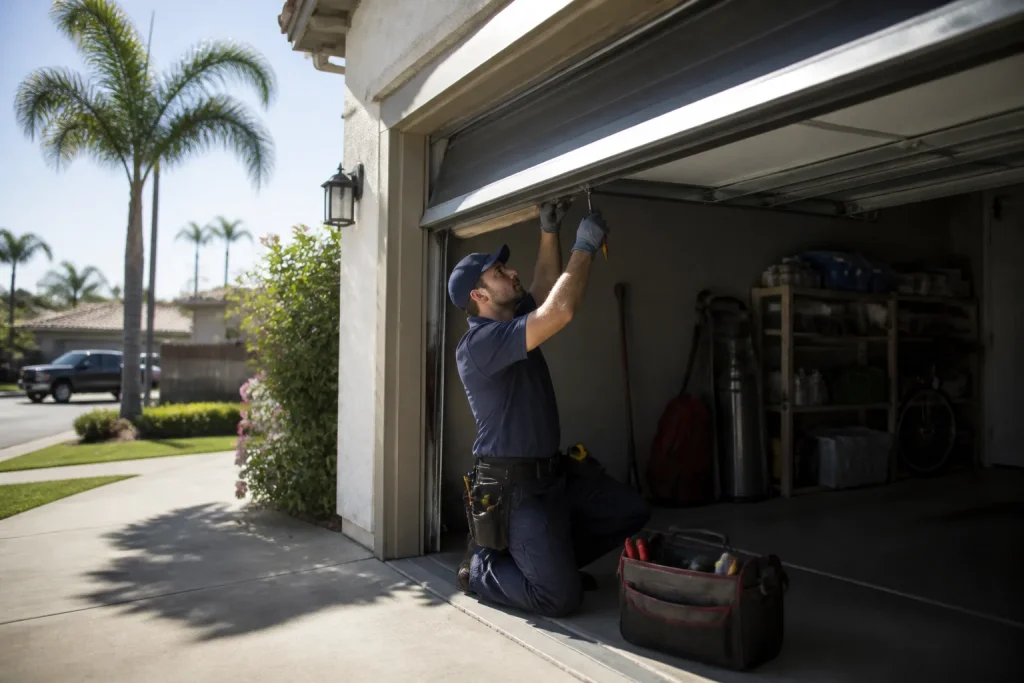
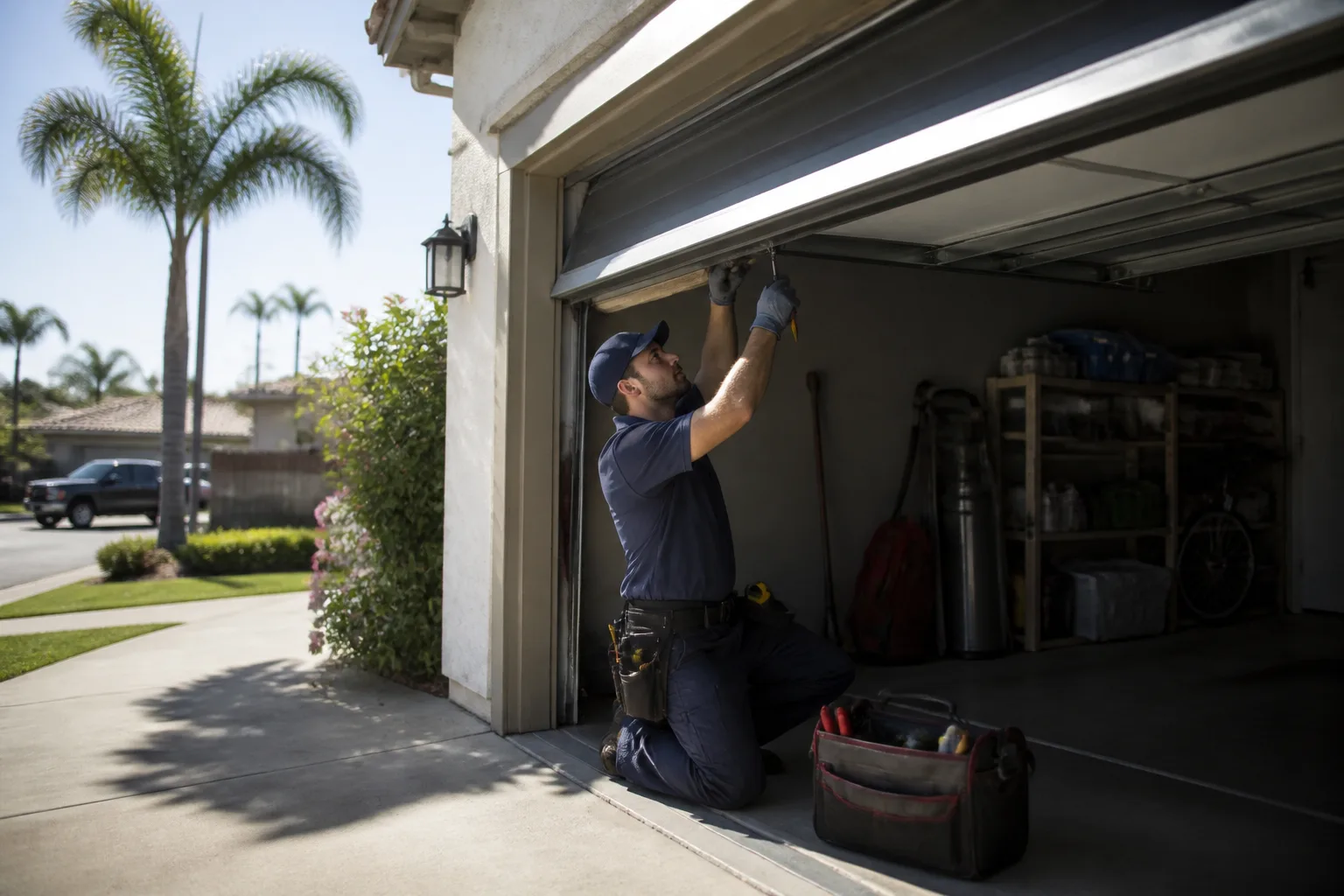
LiftMaster Garage Door Repair in Huntington Beach: A Homeowner’s Guide
LiftMaster garage door repair in Huntington Beach usually comes down to one of three things: a failed logic board, a stripped drive gear, or a MyQ connectivity problem that gets mistaken for a dead motor. The opener itself is rarely the culprit. If you’d rather not spend your Saturday on a ladder with a multimeter, call (833) 620-3836 and we’ll sort it out.
Here’s the part nobody tells you: LiftMaster is the most-installed opener brand in Huntington Beach, which also makes it the most misdiagnosed. Technicians who aren’t fluent in the MyQ ecosystem regularly swap out mechanical parts when the real issue is a firmware or network configuration problem. This guide covers what’s actually different about servicing LiftMaster systems, so you know what to ask before anyone touches your door.
We pulled one out of a garage over in Seacliff last week where a homeowner had been quoted $600 for a new motor. The opener was two years old. The problem? A power surge after an Edison transformer blew knocked the Wi-Fi module offline, and the opener defaulted to a locked state. Took us about fifteen minutes to reset. That’s the kind of thing this guide is meant to prevent.
Key Takeaways
- Serial number prefix tells the story. LiftMaster’s model history maps directly to logic board generations and drive systems. Know yours before you call anyone.
- MyQ failures are not motor failures. A two-minute test separates a network issue from a mechanical one.
- Security+ 2.0 changed everything after 2011. Aftermarket remotes that worked on older units often won’t pair with newer ones, and that’s by design.
- Warranty coverage varies by product line. A non-authorized tech can accidentally void what LiftMaster would otherwise cover.
- Repair vs. replacement math is predictable. Once an opener passes a certain age and repair cost threshold, replacement becomes the honest recommendation.
At Corner Post Garage Door Repair home, we work on LiftMaster openers daily. We’re not here to sell you a new unit unless the numbers actually support it.
How to Identify Your LiftMaster Model Before You Call
Every LiftMaster opener has a model number on a label attached to the motor housing, usually near the light lens or on the side rail. But the serial number prefix is what tells a technician which generation of logic board and drive system you’re dealing with. In Huntington Beach, where salt air accelerates corrosion on exterior-mounted components, knowing your exact model matters more than it does inland.
LiftMaster’s production history breaks down into rough generations. Units made before 2011 run on Security+ (non-2.0) rolling code and use simpler logic boards that are now discontinued but still repairable through aftermarket suppliers. Units from 2011 through roughly 2022 use Security+ 2.0, which introduced a different encryption protocol and a logic board that fails in predictable ways, particularly on capacitor discharge. The newest units, including the 84501 and 87504 series, integrate MyQ directly into the board and are far more network-dependent than most homeowners realize.
Why does this matter for Huntington Beach specifically? Because our coastal humidity and salt exposure shorten capacitor life. We regularly see openers that are only five years old with capacitors that would last ten years in Anaheim or Fountain Valley. If a tech doesn’t know which generation your unit is, they’ll misdiagnose the failure and start replacing parts that were never the problem.
Write down the model number and serial prefix before you call anyone. It takes thirty seconds and it changes the entire conversation.
MyQ Connectivity Failure vs. Actual Motor Failure: The Two-Minute Test
This is the misdiagnosis we see most often in Huntington Beach. A homeowner presses the wall button or remote, the door doesn’t move, and the assumption is the motor died. What actually happened, in a surprising number of cases, is that the MyQ module lost its Wi-Fi pairing or entered a locked state after a power event.
Here’s the two-minute test. Step one: press the wired wall button. If the opener runs from the wall button but not from the app or a remote, the motor is fine and the issue is in the MyQ module, the remote programming, or the antenna. Step two: if the opener runs from a remote but not the app, the problem is specifically MyQ connectivity, not the opener’s core function. Step three: if nothing works from any input and you hear a click or hum from the motor housing, then you’re likely looking at a capacitor or logic board issue.
In our experience, roughly a third of “dead motor” calls in Huntington Beach turn out to be MyQ pairing failures or locked states caused by power surges. Huntington Beach’s grid has seen its share of transformer blowouts near the beach neighborhoods, and every surge event creates a wave of these calls.
The fix for a MyQ failure is typically a reset and re-pair, which involves clearing the module’s memory and reconnecting it to your home network. The fix for a motor failure is a replacement motor or opener. The cost difference is hundreds of dollars, so run the test before you authorize any work.
Security+ 2.0 and Why Aftermarket Remotes Fail to Pair
LiftMaster introduced Security+ 2.0 in 2011, and it changed remote compatibility forever. Before that, aftermarket universal remotes could learn almost any LiftMaster signal. After Security+ 2.0, the rolling code encryption changed, and most older aftermarket remotes simply won’t pair with post-2011 units.
We see this exact scenario in Huntington Beach constantly. A homeowner buys a universal remote from a hardware store in Beach Boulevard or online, follows the instructions, and the remote won’t sync. They assume their opener is broken. The opener isn’t broken; the remote just isn’t compatible with Security+ 2.0’s encrypted handshake.
The workaround is to buy a remote that explicitly states Security+ 2.0 compatibility, or to use LiftMaster’s own remotes and keypads. Chamberlain and Genie both make Security+ 2.0-compatible aftermarket options for some models, but not all. If you’re unsure whether a remote will work with your specific unit, check the model’s documentation or ask a technician who works on LiftMaster daily.
This also applies to older gate openers and commercial remotes. A remote from a Clopay or Amarr door installation isn’t automatically compatible just because the door brand matches. The opener dictates remote compatibility, not the door panel manufacturer.
One more note: if your opener is from before 2011 and still running, its remote protocol is technically easier to duplicate, which is a security consideration. Huntington Beach homeowners with pre-2011 openers should consider whether an upgrade makes sense, especially if the opener is original to a house built in the 1990s or early 2000s.
LiftMaster Warranty Coverage: What’s Covered, What Voids It
LiftMaster’s warranty structure varies by product line. Their premium models, like the 87504 series and the Elite line, generally carry lifetime motor warranties and longer parts coverage, often five years on the belt and major components. Their entry-level chain drive models carry shorter coverage, typically one to three years on parts. But here’s what most Huntington Beach homeowners don’t know: who installs or repairs your opener can directly affect whether you can claim under warranty.
LiftMaster’s warranty terms specify that work must be performed by an authorized dealer or a qualified technician for the warranty to remain intact in certain situations. A non-authorized tech who opens the motor housing or replaces the logic board with a non-LiftMaster part can void whatever coverage was remaining. We’ve seen homeowners in Huntington Beach lose warranty coverage on two-year-old openers because a handyman replaced a capacitor with a generic part, and when the board failed six months later, LiftMaster denied the claim because the unit had been opened by a non-authorized party.
What the warranty covers: motor failures, logic board defects under normal use, drive gear failures, and most mechanical failures that occur during the coverage period. What it generally does not cover: damage from power surges, corrosion from salt air exposure, issues caused by improper installation, and failures related to Chamberlain accessories that weren’t designed for your model.
The salt air point matters in Huntington Beach. Openers installed in garages within a mile of the water corrode faster. An opener that fails from corrosion after three years is generally not a warranty claim; it’s a maintenance reality. A technician who knows coastal conditions will factor this into their diagnostic process and their repair recommendations.
If your warranty is still active, always call the original installer or an authorized LiftMaster service provider first. If the warranty has lapsed, you have more flexibility in who does the work, but the quality of the parts and the technician’s familiarity with LiftMaster still matters for how long the repair holds.
When Repair Makes Sense vs. When Replacement Is the Honest Call
The repair-versus-replace decision for a LiftMaster opener in Huntington Beach follows a predictable formula. If the unit is under seven years old and the repair cost is under $350, repair almost always makes sense. Between seven and twelve years, you’re in the gray zone, and the deciding factor is usually which component failed and what else shows signs of wear. Over twelve years, replacement becomes the default recommendation in most cases, especially for units that have lived their whole lives in a coastal garage.
Specific repair scenarios we see in Huntington Beach that favor repair: a stripped drive gear on a five-year-old chain drive unit is a $150 to $250 fix that extends the opener’s life by years. A failed capacitor or a broken belt tension spring is similarly straightforward. These are mechanical wear items, not failure indicators on the whole system.
Scenarios that favor replacement: a failed logic board on an opener over ten years old, because the board alone costs a substantial portion of a new opener and other components are likely near end of life. A motor failure on an entry-level model from 2015 or earlier, because the replacement motor cost often exceeds the unit’s remaining value. Any unit with visible corrosion on the motor housing or rail, because salt air in Huntington Beach means the rust you can see is only part of what’s underneath.
The 84501 and 87504 series units are particularly worth repairing rather than replacing in most cases, because they’re current-generation product with MyQ integration and parts that are still actively manufactured. An older 3800 or 8500 series jackshaft unit, though, is a different story. Those were discontinued years ago, parts are scarce, and the repair math rarely works in the homeowner’s favor.
When you’re weighing this decision, ask the technician two questions: how much is the repair, and what else on this unit is nearing end of life. A good technician answers both honestly. We do, because we’d rather fix your opener now and earn your trust than sell you a unit you didn’t need.
What Sets LiftMaster Apart (and What Doesn’t)
LiftMaster earned its position as the most-installed opener brand in Huntington Beach for real reasons. Their DC motor lineup runs quieter than most competitors and draws less current, which matters in older Huntington Beach homes where garage circuits may already be near capacity. Their belt drive models are some of the quietest openers available, which matters when the garage sits under a bedroom.
But LiftMaster isn’t magic. The brand’s strengths are in motor longevity and MyQ integration. Their weaknesses are in proprietary ecosystems and remote compatibility. The wall between LiftMaster and Chamberlain accessories, despite being sister brands, frustrates homeowners who assume any Chamberlain accessory should work with any LiftMaster opener. It usually doesn’t, and the reason comes back to Security+ 2.0 protocols.
We work on LiftMaster daily, but we also work on Chamberlain, Genie, Clopay, and Amarr equipment. When a homeowner’s LiftMaster unit is beyond sensible repair, we’re not locked into recommending another LiftMaster. A Genie unit might make more sense for a garage with unusual headroom constraints. A Chamberlain might be the budget-friendly call. Our job is to recommend based on your specific setup, not which box we happen to have in the truck.
That’s the brand-agnostic approach, and it’s the only approach that makes sense for a city like Huntington Beach, where garages range from 1950s single-car layouts in the numbered streets to sprawling three-car bays in Edwards Hill.
When to Call a Pro
Some LiftMaster issues are genuinely dangerous to mess with. The torsion spring on your door, even though it’s connected to the opener system, is under enough tension to cause serious injury if it lets go. If your door is heavy when disconnected from the opener, or if the spring shows visible wear or gaps, stop and call a professional. The same applies to any cable that feeds the spring assembly. These components don’t care about your confidence level.
For the opener itself, call a pro when the problem involves the logic board, the capacitor, or anything that requires opening the motor housing. A capacitor can hold a charge even when unplugged, and the wrong move can damage the board beyond what a replacement would have cost.
What you can safely check on your own: the remote batteries, the photo-eye alignment at the base of the door, the wall button wiring, and whether the opener is getting power at all. Those checks take five minutes and rule out the most common non-issues.
For LiftMaster systems specifically, we’d also say: don’t attempt the MyQ reset sequence from a YouTube video that doesn’t match your exact model. The reset procedure differs between the 84501, 87504, and older Wi-Fi-enabled units, and getting it wrong can leave the opener in a state that’s harder to recover.
Related Services in Huntington Beach
If your LiftMaster issue turns out to be the door itself rather than the opener, or if you’ve decided replacement is the honest call, we handle those too. Our Garage Door Repair in Cudahy page covers mechanical door work, though we serve Huntington Beach with the same expertise. For opener-specific issues beyond LiftMaster, check our Garage Door Opener Repair in Cudahy page. And if replacement is the right move, our Garage Door Installation in Cudahy page walks through what to expect.
We handle the whole system, from spring to opener to new installation, across eight major brands including LiftMaster, Chamberlain, Genie, Clopay, and Amarr. One company, one call, no passing the buck.
What happens when you call
- 1
A real person answersNo phone trees — you reach a local pro.
- 2
You get an upfront price rangeHonest numbers before anyone is dispatched.
- 3
A background-checked tech heads outLicensed & insured, dispatched right away.
- 4
You approve before work beginsNothing starts until you say go.
The Bottom Line
LiftMaster openers are well-built machines, but they’re not simple machines. The MyQ ecosystem, the Security+ 2.0 encryption, and the coastal conditions in Huntington Beach all interact in ways that create specific failure patterns. Knowing your model, running the two-minute test before calling anyone, and understanding your warranty rights will save you money and frustration.
The most important takeaways: identify your model by serial prefix, test the wall button before assuming the motor failed, check Security+ 2.0 compatibility before buying aftermarket remotes, and don’t let an unauthorized tech open your motor housing while the unit is still under warranty.
If you’re in Huntington Beach and dealing with a LiftMaster problem, Corner Post Garage Door Repair offers free estimates. We work on your brand, not around it. Call (833) 620-3836 and we’ll tell you what’s actually wrong before we ever touch a part.
Frequently Asked Questions
Most LiftMaster repairs in Huntington Beach run between $150 and $450 depending on the component. A stripped drive gear typically costs $150 to $250, a logic board replacement runs $250 to $450, and a capacitor replacement is usually under $200. Prices assume the unit is accessible and no additional issues are found during diagnosis. Call (833) 620-3836 for an exact quote, and we’ll agree on the price before any work starts.
Yes, in most cases. We carry common LiftMaster parts on the truck, including drive gears, capacitors, and logic boards for current-model units. If the part is uncommon or the unit is a discontinued model, we may need to source the part, which adds a day or two. Call (833) 620-3836 and we’ll tell you what to expect based on your specific model.
If your opener was made after 2011, it uses Security+ 2.0 rolling code, and many older or generic aftermarket remotes simply won’t sync with it. The remote must explicitly state Security+ 2.0 compatibility. If the remote is compatible and still won’t pair, the opener’s logic board or antenna may be the issue.
Usually not. Once a LiftMaster unit passes ten years in a coastal environment like Huntington Beach, salt air corrosion and general wear mean additional failures are likely. If the repair is a simple drive gear under $200, it may buy you a year or two. But if the logic board or motor has failed, replacement is usually the better financial decision.
No. We diagnose first, quote a firm price, and get your approval before any work begins. The price we quote is the price you pay, unless we discover a second issue that requires a separate discussion and separate approval. You’ll never be surprised by an invoice.
Written by the team at Corner Post Garage Door Repair, serving Huntington Beach since 2015.
Need Garage Door Help?
Call Corner Post Garage Door Repair — licensed & insured, here with fast after-hours help in Cudahy.
(833) 620-3836